

PRELIMINARY STATEMENT ON THE CONDUCT OF SECURITY OFFICIALS AT THE OPENING OF POLLS AT THE 2026 OSUN STATE GUBERNATORIAL ELECTION
Osogbo, Nigeria — 2026-08-15 12:00 PM
“Security Officers Pass Early Test in Osun, but BVAS Malfunctions and Isolated Violence Threaten Smooth Polls at the 2026 Osun State Gubernatorial Election“
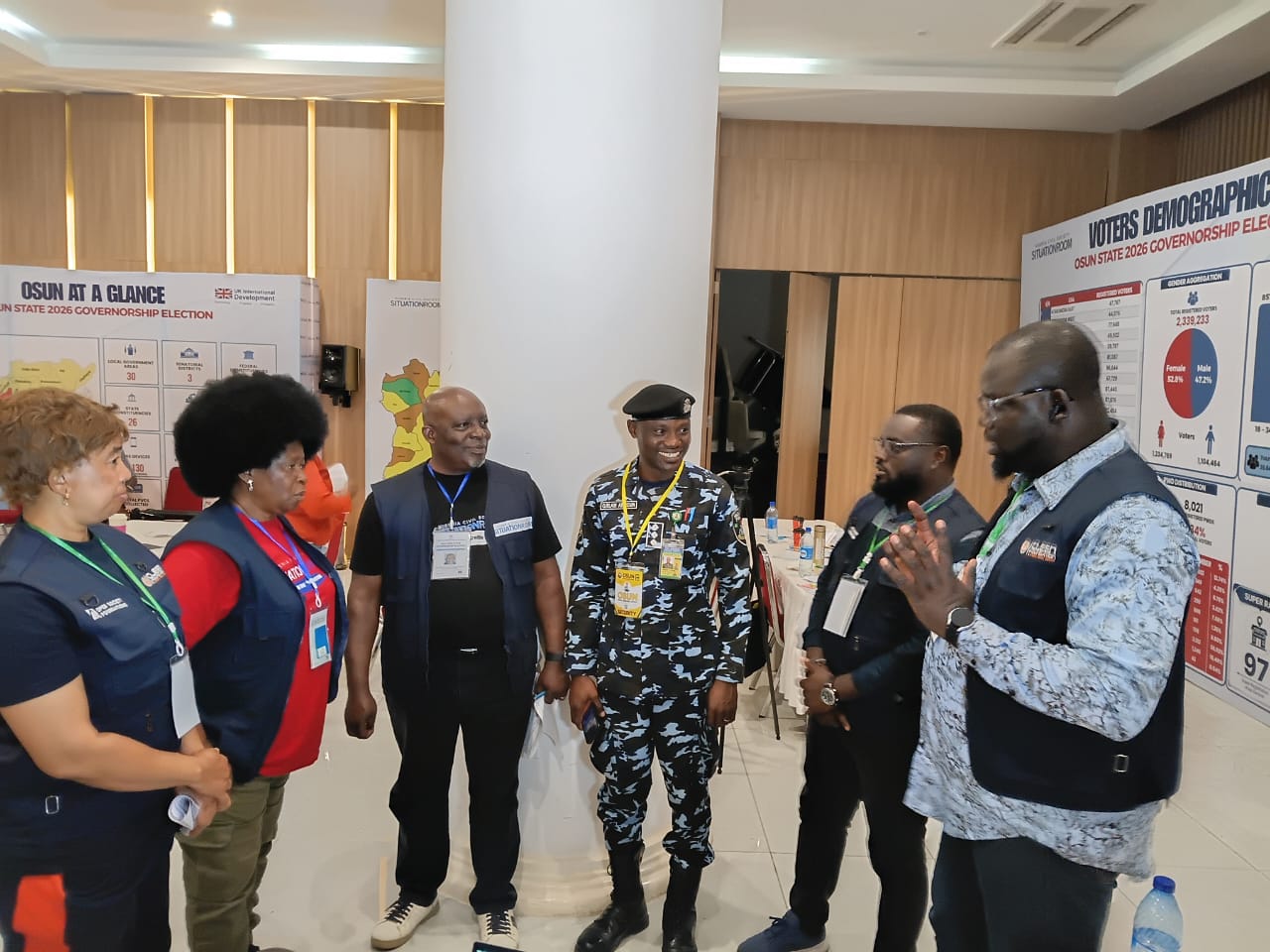
CLEEN Foundation deployed trained election observers to monitor security officials’ conduct at the opening of polls during the 2026 Osun State election. Security sector conduct at polling units is a core indicator of electoral credibility: how officers deploy, identify themselves, and interact with voters and party agents in the opening hours of voting shapes public confidence for the remainder of the process. It is against this backdrop that CLEEN Foundation issues this preliminary statement.
As of 2026-08-15 12:00 PM, observers had submitted reports from polling units across 30 local government area(s) (Atakumosa, Atakumosa West, Atakunmosa East, Ayedaade, Ayedire, Boluwaduro, Boripe, Boripe LGA, Ede South, Egbedore, Egbedore local government, Egbedore local government Area, Ife Central, Ife East, Irewole, Ife Central, Ife East, Ife-North, Ila, Ila local government, Ilasa east, Ilesa East, Ilesa West, Ilesha east, Irepodun, Irewole, Isokan, Iwo, Odo-Otin, Ola-Oluwa, Oriade Lg, Orolu, Osogbo) and 37 ward(s). This statement organises CLEEN Foundation’s preliminary findings under four analytical themes, which are deployment and readiness; professional conduct and public trust; threat and risk indicators; and geographic spread of coverage, followed by representative field notes, a polling-unit-level summary, and CLEEN Foundation’s overall assessment.
Background & Methodology
CLEEN Foundation has monitored the conduct of security agencies during elections and other public order events across Nigeria for over two decades, working to strengthen accountable, rights-respecting policing as a foundation for credible elections. Its election security observation methodology rests on the premise that the presence, professionalism, and impartiality of security officials at polling units materially affect both voter turnout and the perceived legitimacy of results, making systematic, real-time monitoring of their conduct a distinct and necessary complement to conventional election observation, which typically focuses on the voting and counting process itself.
For the 2026 Osun State election, CLEEN Foundation trained and deployed a network of accredited observers who submitted structured, real-time reports via KoboToolbox at the moment polls opened. Each report captures a standard set of indicators: the timing and strength of the security deployment, officer identification, communication capacity, approachability, impartiality, firearms visibility, and any armed groups observed nearby, alongside free-text field notes. This structured format allows findings to be aggregated and compared across polling units in near real time.
As with any observer-based monitoring exercise, these findings reflect the specific polling units where CLEEN Foundation observers were deployed and present at the time of reporting, rather than a statistically randomised sample of all polling units in Osun State. The findings below should therefore be read as an indicative, evidence-based snapshot of security conduct at the opening of polls in the areas covered, which CLEEN Foundation will continue to expand and update as more reports are received throughout election day.
- Deployment, Readiness & Identification
Security deployment at the opening of polls was, overall, timely and adequately staffed. 86% of monitored polling units reported three or more security officials posted to the centre, and 39% of officers had arrived before 7:00 a.m., ahead of the commencement of accreditation and voting.
On identification, 98% of reports confirmed that officers wore easily identifiable nametags and numbers, in line with standard protocol. Officers with visible communication equipment for requesting backup, if needed, were reported in 65% of locations.
Early, adequately staffed deployment matters because the pre-accreditation window is typically when queues form, and tensions around access and orderliness first emerge; a visible, identifiable security presence at this stage tends to set the tone for voter conduct through the rest of the day. The near-universal presence of nametags and service numbers is a meaningful accountability signal in its own right; it means that, should any conduct issue arise later in the day, the specific officer involved can, in principle, be identified, which is a precondition for redress.
For places where observers indicated a lack of visible communication equipment, this should be considered a minor logistical gap rather than a security failure, but it is precisely the kind of gap that can matter if backup is urgently needed later in the day.
- Professional Conduct & Public Trust
Observer assessments of officer professionalism were strongly positive. Officers were rated as approachable or very approachable in 100% of reports, and impartial or very impartial in 80% of reports.
A general sense of safety and security around the polling centre was reported in 100% of locations taken together; observers rated the overall conduct of security officials as good or very good in 94% of monitored locations, describing the atmosphere as generally calm, peaceful, and orderly at the opening of polls.
Approachability and impartiality are the two indicators most directly linked to voters’ willingness to report problems as they arise: voters and party agents are less likely to flag concerns to an officer perceived as unapproachable or partisan in real time, which can allow small issues to go unaddressed until they escalate. The consistency between the approachability, impartiality, and safety-perception figures reported here suggests these are not isolated impressions from a handful of unusually positive locations, but a broadly shared observer experience across the areas covered. CLEEN Foundation will track whether this consistency holds as monitoring extends to the closing of polls, when officer fatigue and the pressure of vote-counting can test professionalism more severely than the opening hours typically do.
III. Threat & Risk Indicators
Officers outside of the immediate perimeter of the polling units were observed visibly armed with firearms. Firearm visibility outside of the polling units is a standard security protocol consideration and is noted here for completeness rather than as an indicator of concern on its own.
No armed groups or political thugs were observed close to any monitored polling unit in this reporting window, a positive early indicator for the security environment at the opening of polls.
CLEEN Foundation reads threat and risk indicators together with, not apart from, the conduct findings above: a professional, approachable security presence is itself a mitigating factor against low-level friction escalating into violence or intimidation. The absence of armed non-state actors at the opening of polls is encouraging, but experience from prior election cycles in Nigeria suggests that risk to voters and observers alike tends to rise later in the day, particularly around collation and the announcement of results at the unit level. CLEEN Foundation’s observer network will continue to track these indicators through the closing of polls specifically to capture any such shift.
- Incident Reports (Election-Day Violence Observer Log)
Since this reporting window began, CLEEN Foundation’s separate Election-Day Violence Observer Log has recorded 3 incident report(s), a distinct data stream from the opening-of-poll conducts observations discussed above and one that CLEEN Foundation treats with particular urgency. Reports were logged from the following location(s): Ola Oluwa (2); Ifelodun (1). In Word 10, Unit 3, Modakeke, Ife-East Local Government Area: Police sho1 teargas canister into standing electorates at the Ward. However, at the time of this report, we can confirm that the officer involved has been apprehended and is undergoing interrogation by the police leadership.
By the reported nature of the incident, the log shows: Verbal/physical intimidation (no weapon seen) (2); Vote Buying (1). CLEEN Foundation notes that these are observer-submitted field reports pending further verification, and are being shared here in the interest of timely public information rather than as a final, corroborated account of events.
CLEEN Foundation calls on the Nigeria Police Force and other relevant security agencies to urgently investigate the incident(s) reported above, to take immediate steps to protect voters, party agents, and observers at the affected location(s), and to ensure that the electoral process is able to continue without further disruption. CLEEN Foundation will continue to monitor these locations closely and will update this statement as more information becomes available.
- BVAS & Voter Turnout
The functionality of the Bimodal Voter Accreditation System (BVAS) was a major focal point and a source of considerable delay. Technical malfunctions were reported in various polling units, ranging from network connectivity failures and difficulties with facial recognition to errors in fingerprint authentication. These issues were observed in locations such as: irepodun, Ward: 6, Polling Unit: 008, Ajele’s Compound where the accreditation process was severely hampered; also LGA like Ilesa East, Ilerin Ward and PU: 7; Irepodun, Ward 6, PU:017; Ifelodun, Ward 06, PU:005 and 006; Irewole, Ward 9, PU 007 (country Lodge). While INEC’s technical teams were seen responding to some of these challenges, the response time and effectiveness were inconsistent, leading to frustration among voters.
Despite these setbacks, voter turnout was mixed. While logistical/operational delays tested people’s patience, many polling units still saw impressive numbers driven partly by voter determination and partly by political inducement.
- Polling Unit-Level Summary
Observations across the visited polling units point to a broadly positive assessment of electoral conduct and security on the day particularly from the position of law enforcement except for the isolated case highlighted earlier. On overall conduct, 57% of polling units were rated “very good” and a further 37% “good,” meaning 94% of units observed met or exceeded acceptable standards, with only 6% rated merely “fair” and no unit rated poorly. This suggests that election-day procedures like accreditation, voting, and results management were largely conducted in line with expected protocols, with deviations, where they occurred, being minor rather than systemic except for the challenges with the BVAS.
Perceptions of safety around polling centers followed a similarly reassuring pattern. 57% of respondents described the environment as “very safe and secure” and 41% as “safe and secure,” together accounting for 98% of responses, while only 2% felt merely “somewhat safe and secure.” No respondent reported an unsafe environment. This indicates that security deployment and crowd management at polling centers were largely effective in reassuring voters and observers, reinforcing the sense of an orderly voting process.
Taken together, the two indicators reinforce each other: units where conduct was rated highly also tended to be those perceived as most secure, suggesting a link between visible security presence, procedural discipline, and public confidence in the process.
VII. CLEEN Foundation’s Assessment
This statement reflects preliminary observations gathered at the opening of polls and does not represent a comprehensive assessment of the full electoral process. Monitoring continues throughout the day, and CLEEN Foundation will issue further updates, including on the closing of polls and any reported incidents, as additional data becomes available.
CLEEN Foundation commends the security agencies for the professionalism observed at this stage and urges continued neutrality, restraint, and adherence to the rule of law throughout the remainder of the electoral process. As the election proceeds to collation and result announcement, CLEEN Foundation calls for heightened vigilance, transparency, and restraint from all actors.
Signed:
Peter Maduoma
Executive Director
Related Posts

COMMUNIQUÉ ISSUED BY STAKEHOLDERS DU RING THE TWO DAYS MULTI-STAKEHOLDERS POLICY LAB ON STRENGTHENING NIGERIA’S ENVIRONMENTAL AND SOCIAL IMPACT ASSESSMENT (ESIA) FRAMEWORK FOR A FUTURE-READY AND JUST ENERGY TRANSITION ORGANIZED BY CLEEN FOUNDATION ON JULY 20th & 21st, 2026 WITH SUPPORT FROM HEINRICH BOLL STIFTUNG.

BEYOND THE BALLOT: EARLY SECURTY ASSESSMENT IN THE EKITI GUBER ELECTION SUGGEST FALCON EYE VIGILANCE, PEACEFUL PROCESS, EFFECTIVE SECURITY COORDINATION WITH MARGINAL CONCERN ON SECURITY NEUTRALITY



Related Posts
COMMUNIQUÉ ISSUED BY STAKEHOLDERS DU RING THE TWO DAYS MULTI-STAKEHOLDERS POLICY LAB ON STRENGTHENING NIGERIA’S ENVIRONMENTAL AND SOCIAL IMPACT ASSESSMENT (ESIA) FRAMEWORK FOR A FUTURE-READY AND JUST ENERGY TRANSITION ORGANIZED BY CLEEN FOUNDATION ON JULY 20th & 21st, 2026 WITH SUPPORT FROM HEINRICH BOLL STIFTUNG.