
For Immediate Release
June 12, 2026
Abuja
Democracy Day 2026: Embedding Community Security Architecture and Criminal Justice Compliance as Foundations of Democratic Practice
On the occasion of Nigeria’s 27th Democracy Day anniversary, the CLEEN Foundation calls on the Federal Government, State Governments, the National Assembly, and all security and justice sector institutions to prioritize the embedding of community-led security architecture and rights-compliant criminal justice reform as foundational pillars of democratic practice in Nigeria. Twenty-seven years after the return to civilian rule, Nigeria’s democracy remains structurally fragile. The persistence of violent extremism, banditry, communal conflict, and organized crime compounded by systemic deficiencies in law enforcement accountability and criminal justice administration demonstrates that electoral cycles alone do not constitute democratic governance. Genuine democracy requires institutions that are responsive to citizens, security systems that communities trust, and justice mechanisms that uphold rights rather than violate them.
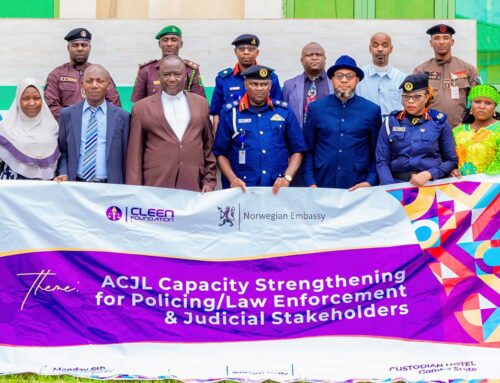
Nigeria’s centralized security architecture has proven inadequate to the scale and complexity of contemporary threats. The proposed State Police reform currently advancing through constitutional amendment represents a generational opportunity to restructure security governance. However, decentralization without community ownership, accountability safeguards, and human rights compliance risks merely fragmenting impunity rather than transforming protection. In similar vein, the Administration of Criminal Justice Act (ACJA) 2015 and its state-level equivalents (ACJLs) remain largely unimplemented. Pre-trial detention abuse, torture in custody, weak prosecution standards, and inadequate legal aid continue to characterize a system that punishes poverty rather than protecting rights.
Urgent Call to Action:
- Federal Government and National Assembly should accelerate structural reforms to decentralize policing frameworks, ensuring the full implementation of the Police Act 2020, and provide legislative and budgetary support for community-driven security partnerships that are transparent and locally accountable.
- State Governments and State Houses of Assembly must localize, finance, and vigorously implement the Administration of Criminal Justice Act (ACJA/ACJL) to eliminate systematic procedural violations, standardize pre-trial oversight, and protect the fundamental rights of citizens within the criminal justice pathway.
- Security Agencies and Oversight Bodies have a responsibility to institutionalize zero-tolerance policies for human rights abuses, enforce strict disciplinary protocols for administrative misconduct, and intentionally implement the Women, Peace, and Security framework by integrating gender-inclusive indicators across operational and command structures.
- Civil Society Organizations and the Media should play their roles in maintaining proactive, objective civic vigilance, actively counter digital threats and disinformation, and collaboratively advocate for greater institutional transparency, holding custodians of state power strictly accountable to democratic norms.
Democracy is not a destination but a daily practice. It is practiced when communities participate in security governance rather than being subjected to it. It is practiced when courts respect due process rather than rubber-stating detention. It is practiced when security forces protect citizens rather than preying upon them.
Signed:
Peter Maduoma
Executive Director