

BEYOND THE BALLOT: EARLY SECURTY ASSESSMENT IN THE EKITI GUBER ELECTION SUGGEST FALCON EYE VIGILANCE, PEACEFUL PROCESS, EFFECTIVE SECURITY COORDINATION WITH MARGINAL CONCERN ON SECURITY NEUTRALITY
For Immediate release
Saturday, 20th June 2026
Ado Ekiti
1.0 INTRODUCTION
The Ekiti State Governorship Election today 20th June 2026, has a total of 1,059,360 registered voters expected to participate across 2,445 polling units spread over 177 wards in the 16 LGAs of the state. Thirteen political parties fielded candidates, led by incumbent Governor Biodun Oyebanji of the All Progressives Congress (APC), Professor Oyebanji Ikusayedegbe Olajuyin of the Labour Party (LP), and Ambassador Oluwadare Patrick Bejide of the African Democratic Congress (ADC), all of whom were among the leading contenders on the ballot.
CLEEN Foundation, in fulfilment of its institutional mandate to enhance election security management and democratic governance in Nigeria, deployed trained 60 INEC accredited observers across all the sixteen (16) Local Government Areas (LGAs) of Ekiti State, to monitor the 2026 gubernatorial elections in the state. Our field deployment sought to independently monitor and evaluate the conduct of security personnel deployed for the governorship election being held on Saturday, 20th June 2026.
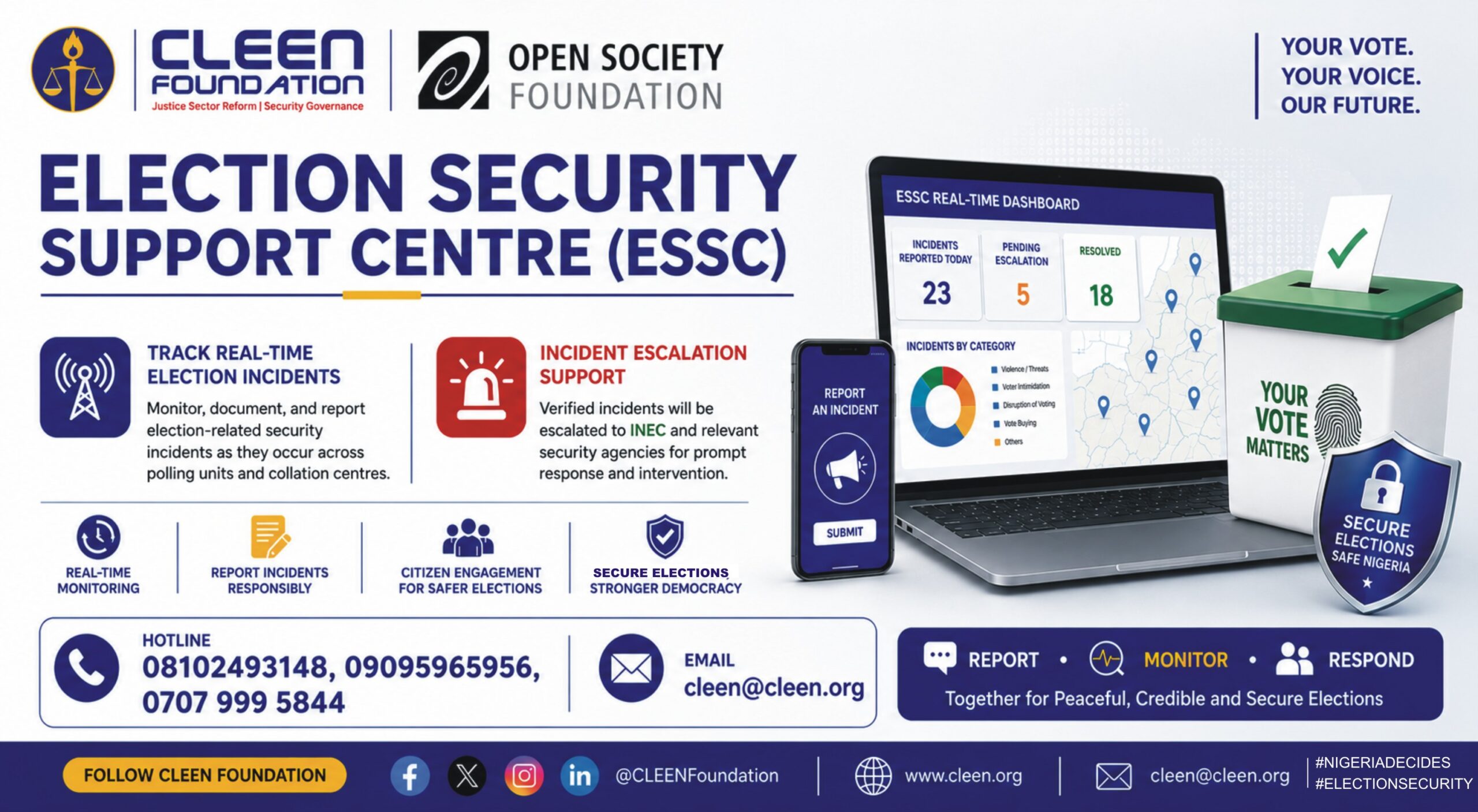
CLEEN Foundation presents this preliminary synopsis. The findings and insights detailed below represent verified, real-time data transmitted through our over 60 stationary and roving observers making use of proprietary mobile tracking applications on the conduct of security officials during the election.
2.0 METHODOLOGY
The CLEEN Foundation adopted a triangulation approach in tracking, documenting, and reporting the conduct of security personnel during the 2026 Ekiti State Governorship Election, which relies on a multi-tiered data gathering framework. The approach balances qualitative observation with quantitative data tracking to provide a holistic, real-time assessment of election security. Observers were deployed across the 16 Local Government Areas (LGAs) in Ekiti state, complemented by roving observers and media tracking by the CLEEN Foundation Election Security Support Centre (ESSC). The Observers utilised a standardised checklist mapped directly to international best practices for democratic policing and national electoral security guidelines. The ESSC utilised a secure platform and received and analysed data from the field used to generate this preliminary report.
3.0 FIELD OBSERVATIONS & FINDINGS
3.1: Early Arrival and Presence of Law Enforcement personnel:
Field reports indicated a significant and highly visible security presence across most parts of the state, with security personnel arriving early to match official timelines, wearing visible, identifiable nametags and unarmed. Data received from the CLEEN Foundation Observers and analyzed by the Election Security Support Centre indicates that 90% of law enforcement personnel arrived early at the various polling units in the ongoing Ekiti state 2026 governorship election. In Oye LGA (Ward 10, PU 015), Ekiti North Senatorial Zone, mixed security forces arrived early alongside election officials to start the process on schedule. A similarly disciplined presence was observed in Ikole LGA (Ward: Ikole North 04, PU 001, in front of Anifowose’s House), where three police officers were on-site to secure the timely arrival of the electoral agency. In Moba LGA (Ward: Erinmope 2, Code 004, at Community Primary School Irare), a strong mixed team of three police officers and two NSCDC personnel established a reassuring security posture.
Area of Concern: Despite these positive turnouts, isolated gaps occurred. Observers in Ijero LGA (Ward D (04), PU 002) recorded an incident of “No security presence,” raising concerns about inconsistency and uneven distribution of personnel.
3.2 Adequacy of Security Officials Deployed
The majority of polling units observed, representing 82.9%, had three or more security officials posted, providing adequate coverage for the management of crowd control, voter assistance, and incident response. Six polling units, accounting for 14.6%, had two officers deployed, while only one polling unit, representing 2.4%, had no security presence at all. This latter case, identified in Ijero LGA (Ward: D (04), PU: 002), represents a significant gap that raises concerns about the consistency of security deployment across the state. The presence of multiple security personnel at most polling units enabled effective collaboration between security agencies, with observers documenting instances where Police officers, NSCDC personnel, and other security agencies worked side by side to maintain order and ensure the smooth conduct of the electoral process.
3.3 Identification and Professional Appearance of Security Personnel
Majority of CLEEN Foundation observers 98% noted that polling units observed had two or more law enforcement personnel present at the polling unit and no polling unit was without a law enforcement personnel. Similarly all the law enforcement personnel were observed to be wearing easily identifiable name tags/number in the ongoing governorship election in Ekiti state.Specifically in Ado LGA (Ward: Ado D Ijigbo, PU 008, St. Thomas Primary School Oke Oniyo), where voting commenced precisely at 8:30 a.m. under the watch of two police officers and an NSCDC official with their name tags displayed. Also, in Oye Ekiti LGA (Ward: Ayedesouth, PU 004, St. Luke Primary School Itaji Ekiti), a robust team of four police officers were later joined by two Man O’ War officials, ensuring a peaceful environment where voter orientation was smoothly conducted by 8:33 a.m.
3.4 Use of Face Masks by Security Personnel
Observers reported that the overwhelming majority of security officials, representing 95.1%, were not wearing face masks during the election. Only two officers, accounting for 4.9%, were observed wearing face masks. While no specific health advisory was in effect at the time of the election, this observation suggests a need for better compliance with health protocols during future elections, particularly if respiratory illness outbreaks are a concern. The low usage of face masks may also reflect a broader relaxation of health protocols across the country, but security agencies should maintain contingency plans for health safety measures to protect both personnel and the public during electoral activities.
3.5 Approachability of Security Officials
An impressive 95.1% of security officials were rated as approachable (43.9%) or very approachable (51.2%) by observers. Only 2.4% were considered somewhat approachable, and 2.4% were not approachable at all. This high level of approachability is indicative of community-friendly policing, which likely contributed to the peaceful atmosphere observed during the election. Observers noted that approachable officers were more effective in calming tensions, providing direction to voters, and facilitating the resolution of minor disputes at polling units. The approachability of security personnel also encouraged voters to report concerns and seek assistance when needed, thereby enhancing the overall voter experience and confidence in the electoral process.
3.6 Public Perception of Safety and Security
All observers, representing 100% of respondents, indicated that voters felt either safe and secure (31.7%) or very safe and secure (68.3%) around the polling centres. This outstanding outcome reflects positively on the overall security management during the election and validates the effectiveness of the security deployment strategy. The presence of security personnel appears to have successfully reassured voters and created an enabling environment for the exercise of democratic rights. Observers noted that voters, including women, elderly persons, and persons with disabilities, participated in the electoral process without visible fear or intimidation, which is a testament to the security agencies’ ability to maintain law and order throughout the election.
3.7 Arming of Security Personnel
The majority of security officials, representing 82.9%, were observed to be unarmed, while only 14.6% were armed with firearms. One observer, accounting for 2.4%, was unsure whether officers were armed. This reflects a predominantly soft approach to security, which is consistent with the overall peaceful conduct of the election and the emphasis on maintaining a non-intimidating atmosphere at polling units. The limited use of firearms likely contributed to the high levels of public confidence and approachability observed during the election, as voters were not confronted with excessive displays of force that could have created fear or tension at polling centres.
3.8 Overall Conduct Rating of Security Personnel
The overall conduct of security officials was rated positively, with 95.1% receiving ratings of “good” (61.0%) or “very good” (34.1%). Only 2.4% received a “fair” rating, and 2.4% received a “condemnable” rating. This demonstrates that the vast majority of security personnel conducted themselves professionally throughout the election, adhering to the Code of Conduct for Election Duty and maintaining order in a manner that facilitated the smooth conduct of the electoral process. The positive conduct ratings are consistent with other indicators, such as approachability and public safety perception, and suggest that security personnel largely fulfilled their duties in a manner that upheld the integrity of the electoral process.
3.9 Conduct of Security Personnel during Voting and Accreditation
Observers documented that security personnel conducted themselves professionally during the voting and accreditation process across the state. In Oye Ekiti LGA (Ward: Ayede south, PU: Unit 004), voter orientation was conducted at 8:33 a.m., indicating effective cooperation between security officials, ad hoc staff, and voters. Reports from Ekiti East LGA confirmed that accreditation proceeded in a peaceful conduct, with election materials arriving accompanied by security operatives. In Ado LGA, at St Thomas Primary School, the voting process commenced at precisely 8:30 a.m. with security agents present (2 Police officers and 1 NSCDC officer) and voting materials available. Security personnel were observed managing queues, ensuring orderly conduct, and assisting vulnerable voters, including the elderly and persons with disabilities, in accessing polling units and participating in the electoral process without hindrance.
3.10 Intervention in Electoral Malpractice
At Irepodun/Ifelodun LGA (Ward: 14, PU: Open space at Osekita junction, Iworoko), observers documented a suspicious case of vote buying where a voter revealed his vote and it was captured by the person it was revealed to. Security personnel, in collaboration with party agents, immediately cautioned the erring electorate, demonstrating appropriate intervention by security officials in preserving the integrity of the electoral process. This incident highlights the importance of security personnel being vigilant and proactive in addressing electoral malpractices, and the effective collaboration between security agencies and other stakeholders in upholding electoral integrity. The swift response to this incident likely deterred other potential violations and reinforced the message that electoral offences would not be tolerated.
3.11 Response to BVAS Functionality Challenges
Reports from several polling units indicated challenges with BVAS functionality, particularly during voter accreditation. In Irepodun/Ifelodun LGA, a BVAS malfunction generated complaints from voters; however, there were no reports of violence or disruption, suggesting that the presence of security personnel helped maintain order. Similarly, in Ise/Orun LGA, Ward 03, PU 009, a faulty BVAS device was repaired but continued to experience intermittent difficulties, particularly in capturing voters’ facial biometrics. Additional BVAS-related challenges were reported across the state. In Oye LGA (Ward 5, PU 5), accreditation was delayed due to an initially non-functional BVAS, although the device became operational and accreditation resumed at 9:41 a.m. In Ado Ekiti (Oke Ila, PU 07) and Odo/Osi LGA, several elderly voters experienced difficulties with fingerprint and facial authentication. Likewise, in Ado Ekiti Ward 11, BVAS performance improved after voters cleaned their fingers with sanitizer, but some elderly voters continued to face delays during the accreditation process
3.12 Deployment of Election Logistics and Security Coordination
The joint deployment of security personnel under the Inter-Agency Consultative Committee on Election Security (ICCES) framework was implemented to secure the movement of electoral materials and personnel. Early arrival of election materials was a prevailing pattern across many LGAs, including Oye, Gbonyin, Ise/Orun, Ikole, Ekiti East, MOBA, and Ado, suggesting that logistics for material deployment were effectively secured. The Nigerian Air Force played a supportive role by airlifting sensitive electoral materials between 15th and 16th June to ensure secure delivery ahead of the election. In Ekiti East LGA, election materials arrived at 7:12 a.m., while reports from Ise/Orun LGA confirmed that electoral materials arrived timely followed by security personnel. However, the exception of missing Braille ballot guides and magnifying glasses for Persons with Disabilities (PWDs) in Ise/Orun represents a logistical gap that requires attention.
3.13 Activities of Party Agents and Collaboration with Security Personnel
Party agents were observed playing both constructive and concerning roles across the monitored polling units. In Irepodun/Ifelodun LGA, party agents reportedly joined security personnel and election officials in cautioning an individual involved in an alleged vote-buying incident, reflecting a collaborative effort to uphold electoral integrity and maintain order at the polling unit. Observers also reported positive voter engagement activities in some locations. In Ekiti East LGA (Community Grammar School, Kota Omuo, PU 06), there was a notable turnout of women voters, while in Ado Ekiti, voters were seen verifying their details on the voters’ register with support from election officials and party agents.
However, concerns were raised regarding the conduct of some party agents. In Ado Ekiti (Oke Ila Ward, PU 07), party members were reportedly issuing tally slips to voters after they had cast their ballots and directing them to a location outside the polling unit, raising suspicions of possible vote-buying or voter inducement. Similarly, in Ijero LGA (Ward D, PU 002), observers reported instances of voters being influenced by party agents. These incidents underscore the need for closer monitoring of party agent activities to ensure compliance with electoral guidelines and to safeguard the integrity of the voting process.
Based on the observations and data analysis, CLEEN Foundation offers the following recommendations:
- Mandatory Impartiality Training for Security Personnel: Security agencies should develop and implement mandatory training programs focused on impartiality, neutrality, and professional conduct during elections, particularly given that 46.3% of security officials were perceived as not impartial. This training should emphasize the importance of remaining apolitical and treating all voters and political actors equally, regardless of their affiliations. Regular refresher courses should be conducted prior to every election cycle, with practical scenarios and case studies drawn from past elections to reinforce learning and ensure that officers understand the consequences of partisan conduct.
- Strict Enforcement of Code of Conduct: The Nigeria Police Force and other security agencies should strictly enforce the Code of Conduct for Security Personnel on Election Duty, with clear and transparent sanctions for violations. A dedicated complaints mechanism should be established to receive and investigate reports of misconduct by security personnel, with findings made public to enhance accountability. Officers found to have engaged in partisan conduct or other forms of misconduct should face disciplinary action, including possible dismissal, to serve as a deterrent to others and restore public confidence in the impartiality of security agencies.
- Implementation of Rotational Deployment Policy: Security personnel should be deployed away from their communities of origin during elections to minimize the risk of bias, familiarity with local political actors, and potential conflicts of interest. A rotational deployment policy should be institutionalized, ensuring that officers are assigned to polling units and LGAs where they have no personal, familial, or political connections. This will enhance perceptions of impartiality and reduce the likelihood of undue influence or partisan conduct by security personnel.
- Elimination of Deployment Gaps: INEC and the Nigeria Police Force should ensure a more consistent security deployment model to eliminate gaps where polling units have “no security presence,” such as the case identified in Ijero LGA (Ward: D (04), PU: 002). This should include improved intelligence-led deployment, pre-election mapping of all polling units, and rapid response mechanisms to address any deployment gaps identified on election day. A real-time monitoring system should be established to track security deployment across all polling units and enable swift corrective action.
- Timely Deployment Protocols: While 90.3% of security personnel arrived on time, the 9.8% that arrived between 8:00 am and 8:59 am should be addressed to ensure 100% deployment before the official commencement of voting. Security agencies should establish clear protocols for early deployment, including pre-positioning of personnel at strategic locations the night before elections, and ensuring that logistical support is available to facilitate timely arrival at polling units regardless of weather conditions or other potential delays.
- Enhanced BVAS Technical Support: INEC should accelerate the resolution of BVAS technical failures by providing multiple backup units, ensuring that technical support teams are rapidly deployable to polling units to prevent operational delays. A dedicated BVAS technical helpline should be established for election day, with support personnel strategically positioned across LGAs to respond quickly to technical challenges. Security personnel should be trained on basic BVAS troubleshooting to assist INEC officials and reassure voters during technical difficulties.
- Enhanced ICCES Coordination: The Inter-Agency Consultative Committee on Election Security (ICCES) should maintain its robust coordination to further strengthen joint deployment and ensure seamless security coverage in future elections. Regular joint training exercises, operational planning sessions, and after-action reviews should be conducted to enhance inter-agency cooperation and ensure that all security agencies are aligned in their approach to election security management. A unified command and control structure should be maintained on election day to ensure effective coordination and rapid response to incidents.
4.0 CONCLUSION
CLEEN Foundation concludes that the conduct of security personnel during the Ekiti State Governorship Election was largely professional, with an effective security presence that contributed to a peaceful electoral process. The early arrival of election materials accompanied by security operatives in most polling units was a positive development. The high levels of approachability (95.1%) and the positive overall conduct ratings (95.1% good or very good) reflect well on the professionalism of the security personnel deployed.
However, significant concerns remain. The perception that 46.3% of security officials were not impartial is deeply troubling and undermines public confidence in the electoral process. The isolated incident of “no security presence” in one polling unit, along with the attack on the Isan Police Station on the eve of the election, highlights the vulnerabilities in the security architecture that must be addressed.
CLEEN Foundation commends security agencies for their role in maintaining a peaceful atmosphere and intervening in incidents of electoral malpractice, such as vote buying. The fact that 100% of voters felt safe or very safe around polling centres is a testament to the effectiveness of the security deployment.
We urge the Nigeria Police Force and other security agencies to build on these successes and address the identified gaps, particularly on the issue of impartiality, to enhance future electoral security management. The CLEEN Foundation will continue to promote public safety and security as a cornerstone of democratic governance.
Signed:
Peter Maduoma
Executive Director,
CLEEN Foundation
Related Posts


CLEEN Foundation Expresses Alarm Over Persistent Security Failures Despite Safe School Initiative and the National Safe School Response Coordination Centre



Related Posts